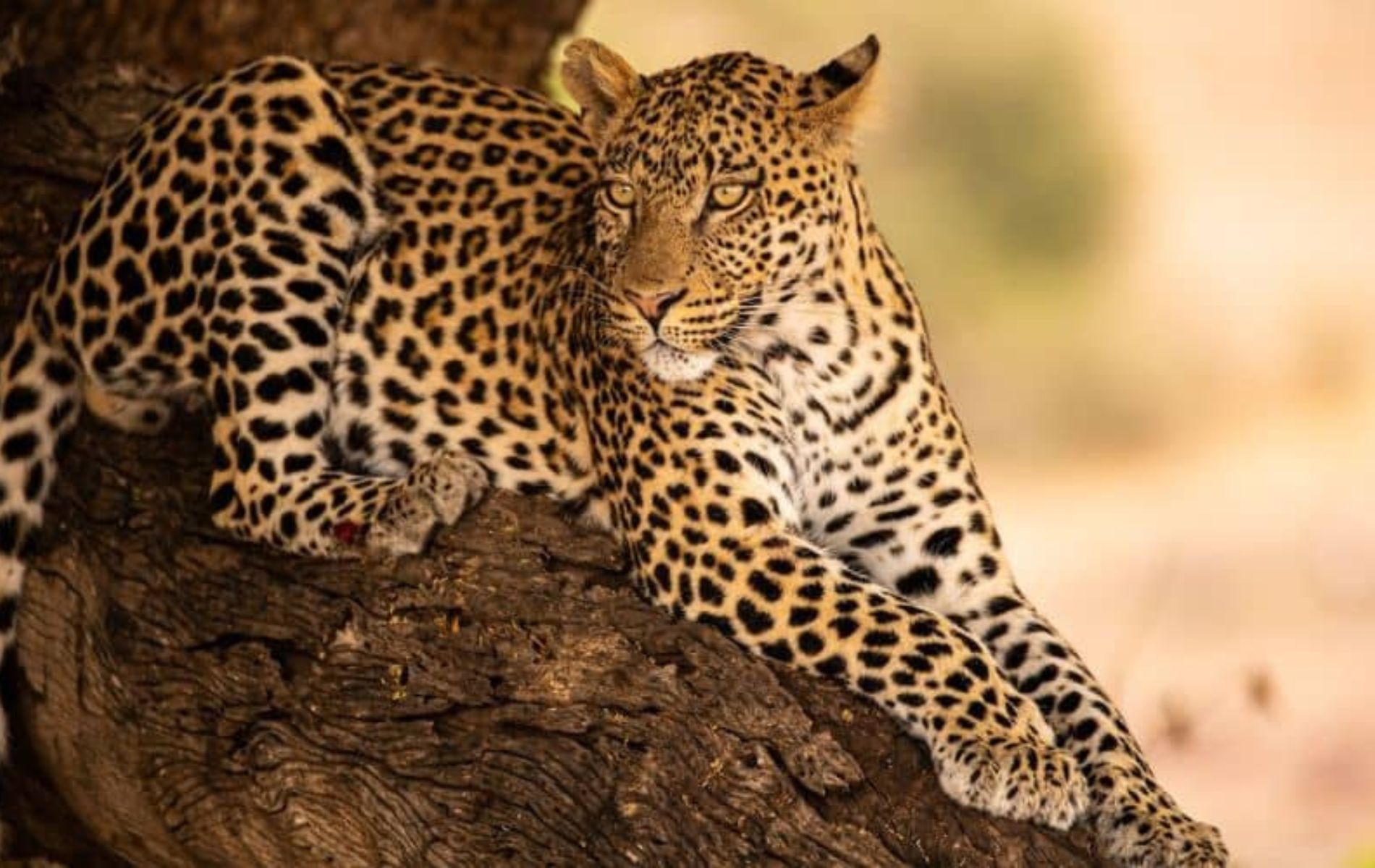
A leopard is a cat like no other. An African leopard is one of the biggest, deadliest cats in the world. Interestingly, these cats are also the most misunderstood and misrepresented. You won’t be the first person to mistake a leopard for a cheetah, jaguar, or tiger. It’s quite a common occurrence. But worry not, this post will give you all the African leopard facts you need to be able to distinguish them from others of their kind.
What is the African leopard?
The African leopard is the smallest of the big cats. Unlike cheetahs, leopards have a shorter torso and neck, thicker legs, and a 90 cm tail. Their coats are short and are coloured (pale straw, grey buff to deep ochre) to mesh with the dry grass in the savannah. The African leopard has large black spots grouped into rosettes on the shoulders, back, upper arms, and flanks. lower limbs, head, neck, and throat have smaller spots, while the belly has large blackish blotches.
This leopard is quite the winner at camouflaging and is active at night to stay hidden. So don’t be surprised if it takes you a couple of game drives to spot a leopard. Their ability to hide in plain sight might explain why they’re larger in numbers compared to other Africa big cats.
The leopards have expendable claws on each toe, which help in hunting and climbing trees. They also have long muscular tails that aid in balance when running at fast speeds as well as steer movement.
Habitat
African leopards are more adaptable than any other African big cat and can survive in almost any habitat, including forests, grassland savannahs, deserts, woodlands, coastal scrubs, mountains, and swampy areas. Leopards are also one of the few big five species found outside national parks.
Behaviour
Unlike other animals, leopards are solitary, independent creatures and don’t move in groups unless when they’re mating. This has made them earn the title ‘introverts of the wild’. If you see a group of leopards, chances are that’s a mother with its cubs. This solitary nature makes them self-reliant and expert hunters. They’re such skilled hunters that they can, at times, kill prey up to twice their size (remember, a single leopard will do this on its own).
If you’re on a day game viewing drive, look out for leopards on trees where they often lounge as they eat their prey—which they hunt after dark.
Leopards, unlike their cousins, the lions, don’t have family ties. Social ties go as far as the females taking care of their young and teaching them survival skills. Cubs are independent at 22 months, but due to strong maternal bonds, their mothers will keep them around for longer, nurturing them until they’re fully ready for a solitary life.
Diet
Leopards are carnivores but have a more flexible diet as they’re not as picky as other big cats. However, even though they’re not picky eaters, individual leopards tend to develop a taste for certain animals and will hunt these specific animals almost exclusively.
Most leopards eat smaller wild animals like gazelles, baboons, cheetah cubs, snakes, rodents, monkeys, antelope, and warthogs. They’re also good swimmers and will often take a dive to catch fish or crabs.
Just like cheetahs, leopards are ambush predators. They observe and pounce from up a tree. With its legs bent, head low, and its belly almost touching the ground, it crouches and stealthily sneaks up on prey for 3 to 10 minutes before pouncing. After a successful mission, the leopard will hoist its carcass up a tree, out of reach and sight for other big cats. Here, they’ll eat large prey slowly over several days.
African leopards are not big water drinkers. They survive on moisture in the prey they eat.
Best places to see African leopards
African leopards have a heavy presence in parks in sub-Saharan African countries. If you’re looking for places to see a leopard, a safari to Samburu National Reserve, Kenya, Serengeti National Park, Tanzania, Londolozi Game Reserve, South Africa, Moremi Game Reserve, Botswana, or South Luangwa National Park, Zambia will give you the highest chances of spotting a leopard.
Fun leopard facts
-
Leopards can run at a speed of 58kph, can jump 6 meters forwards and leap 3 meters straight up.
-
Leopards are nocturnal and spend most of their night hunting and sleeping during the day.
-
An African leopard is very strong and can carry a carcass heavier than itself.
-
Though they are cats, leopards rarely roar and often let out a raspy bark.
-
A leopard’s ear can hear five times more sound than a human ear.
-
Just like human fingerprints, no two leopards have the same markings or spots.
Want to see an African leopard up close? Contact us today, and we'll take you on the best safari in Africa, where you'll see not only the African leopard but the other big five game as well!