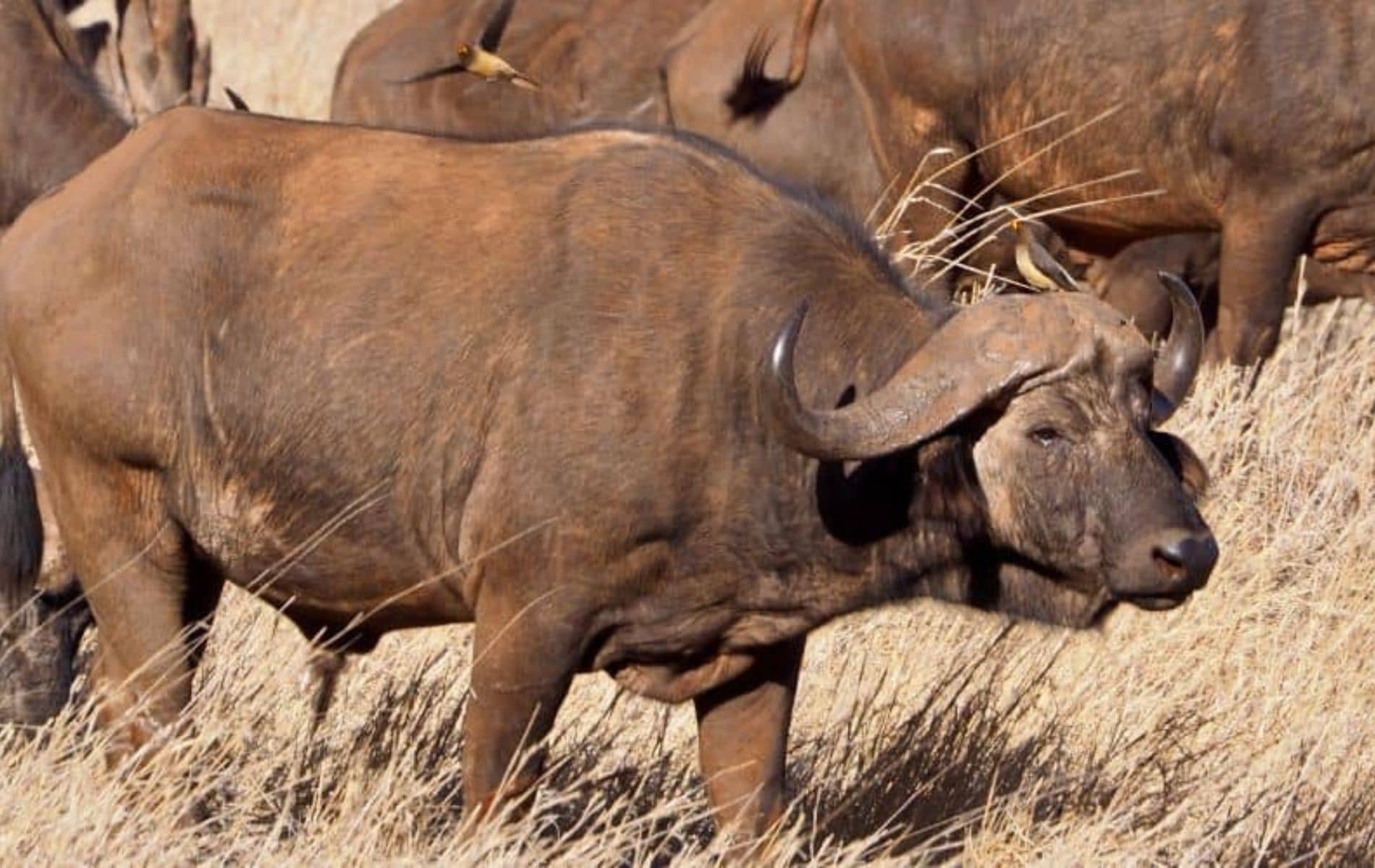
Out of all the animals in the Big Five, the Cape Buffalo is the most dangerous and aggressive one. Known as the Mafia of the jungle, these buffaloes are aggressive and furious hunters and can kill predators like lions or cheetahs. They’re also known to attack humans the most, so be very careful when you spot a Cape buffalo during your African safari. Just watch it from afar without disturbing it.
Are you ready to learn more? Here are just a few African buffalo facts to get you started.
What is the Cape Buffalo?
Africa has one buffalo species and four distinct subspecies: forest buffalo, West African savanna buffalo, Central African buffalo, and southern savanna buffalo (also known as the Cape buffalo).
The Cape buffalo is a large, heavy cow-like animal. This subspecies varies greatly from the rest. An adult Cape buffalo is usually dark grey or black and will appear red or white if they have been wading in mud of that colour. A baby Cape buffalo is often reddish-brown. In comparison, a baby forest buffalo maintains the red colour even as an adult. Adult Cape buffaloes lose hair as they age.
Both male and female Cape buffaloes feature heavy, ridged horns that grow straight out from the head or curve downward and then up.
Unlike most animals, a buffalo’s head sits lower than its backline. This makes its front heavier than its back. As a result, the buffalo’s front hooves are wider in order to support this weight. The Cape buffalo has a wide row of incisor teeth and a deft tongue—two features that enable it to eat grass faster than most African herbivores, such as the African Elephant.
Habitat
The Cape buffalo is the most popular subspecies of the buffalo found in Southern and East Africa.
Behaviour
Cape buffaloes are famous for their unpredictable temper. Unlike their counterparts, the Asian water buffalo, the Cape buffalo is impossible to domesticate. Their temper makes them extremely dangerous and difficult to hunt, so it’s no surprise they made it to the list of Africa’s Big Five.
Nothing is as dangerous as a buffalo’s majestic set of horns (popularly called a “boss”). The animals use these formidable weapons to fight predators and to hustle for space within the herd. Males also use their horns in fights for dominance.
The Cape buffalo can spend as much as 18 hours a day active, mostly grazing or chewing the cud. The buffaloes move in herds and will often stay close together as they graze. Buffaloes are tenacious and have a strong ability to defend themselves from predators. Often, groups of herds will stick together during grazing as a defence mechanism. In such a large group, it’s hard for a predator to pick and separate individual animals. The buffaloes also keep their calves in the centre of the herd for optimum protection from predators and elements.
Male Cape buffaloes move in and out of herds. They’ll often split during dry seasons and form bachelor herds. They then rejoin their original herds during the wet seasons to mate with the females. If the females get pregnant, the males stay with the herd to protect their calves.
Diet
No matter where it roams, however, the buffalo is a particularly successful feeder, easily grazing its way through swamps, floodplains and mopane grasslands and, by so doing, clearing the way for other grazers to follow. Notwithstanding its wide territory, the buffalo is only found where there is water, as these large herbivores require perennial water sources to quench their thirst daily.
The Cape buffalo is a herbivore that feeds on wild tall grass, which they regurgitate and chew on Chewing the cud helps them fully digest all the grass they eat. Buffaloes also consume a colossal amount of water to quench their thirst daily.
Best places to see African buffalo
Ngorongoro National Park and Serengeti National Park are the two best Tanzania destinations to spot the cape buffalos. Other places to see the buffalo are Chobe National Park, Botswana, Kruger National Park, South Africa, and Lower Zambezi National Park, Zambia.
Fun Cape buffalo facts
-
Where there’s a buffalo, there’s an oxpecker and a cattle egret eating biting insects like ticks off its skin.
-
These birds alert the African buffalo before any problem comes towards them.
-
Cape buffaloes have a weak sighting and hearing power but very sharp memory. If you trouble a buffalo, it will remember you even after several years.
-
Their exceptional memory power makes buffaloes one of the most furious revengers on earth.
-
Cape buffaloes have the highest record of human encounters than any predator.
-
African Buffaloes are the only cattle that cannot be domesticated.
-
Male buffaloes have thicker neck skin than females.
-
Cape buffaloes polish use tree trunks to polish their horns and fill the gaps.
-
The African buffalo can sprint at a speed of 37 miles per hour.
Curious to see Cape buffaloes in real life? Book one of our Tanzania safaris, and we’ll take you on a wild adventure in the land of Cape buffaloes!